Creating meaningful transdisciplinary collaborations during the limited time of a PhD — Social-ecological systems Scholars

By My Sellberg, Social-ecological systems scholars

This is the second post in the series on ‘Transdisciplinary PhD Journeys’. Hi there, I am My Sellberg and I am doing a PhD in Sustainability Science at Stockholm Resilience Centre in Sweden. The possibility of doing transdisciplinary research was one of the main reasons for why I decided to do a PhD. The exciting […]

über Creating meaningful transdisciplinary collaborations during the limited time of a PhD — Social-ecological systems Scholars

Regional Identification and Sustainable Tourism in the Nature Park Wildeshauser Geest (Lower Saxony, Germany)

By Moritz Engbers

The dissemination of results is a fundamental aspect of transdisciplinary research. That also holds true for the transdisciplinary projects of the master of sustainability science at Leuphana. Two groups of the transdisciplinary master project “Case Study Oldenburg” presented their results on 11 and 12 April in Hatten and Bassum in the Nature Park Wildeshauser Geest (NPWG). Both presentations were part of a meeting by representatives of the administration of the NPWG as well as mayors and tourism representatives of the municipalities. The administration of the NPWG is working on a plan for the development of the nature park in the comming 10 years. The aim of the student’s presentation was to discuss the results of the transdisciplinary research and possible recommendations for the development of the NPWG.

The first presentation was focusing on the self-understanding of the association of the NPWG. The municipalities as members of the nature park association have quite different understandings about the purpose and goals of the nature park. They are ranging from tourism to nature protection as a major task. A challenge for the future will be to develop a joint understanding of the tasks and goals of the NPWG. The second presentation was about the role of sustainable tourism for a sustainable regional development within the NPWG. The results show that there is no shared understanding of tourism in the nature park. By developing a joint understanding of sustainable tourism and by strengthening the knowledge exchange and collaboration between the administration of the NPWG, the municipalities and tourism providers can contribute to a more sustainable regional development. Afterwards, two representatives from the administration of the NPWG highlighted the recent status of the NPWG with regard to the federal guidelines and explained the further process of the development of an updated plan for the nature park. The transdisciplinary master project was able to provide valuable studies for the further process and important impulses for the discussions. Especially the perspective of the students as “outsiders” was highly appreciated.

The transdisciplinary master projects are running for two semesters. The overall aim is to experience a transdisciplinary process from the definition of a research question and the development of relationships with cooperation partners to the presentation of results. The mentioned transdisciplinary master students project is following up on the guiding question of how nature parks can be potential leverage points for a sustainability transformation in the region of Oldenburg. The results show that nature parks can contribute to a sustainable regional development with regard to sustainable tourism and the identification of actors with the nature park. However, they are based on a quite broad definition in the Nature Conservation Act in Lower Saxony. Furthermore, they are implemented in very different ways in Germany. Nature parks can play an important role as facilitators and organizers within regions that can bring interests and actors together.

The next event within the transdisciplinary case study in the district of Oldenburg will be the Climate Fair in Wildeshausen on the 29 April. The Leverage Points project will be present with a stand together with the artecology_network. The Climate Fair is part of the Spargelfest in Wildeshausen as an important regional event in the capital city of the Oldenburg district.

What we learn by being [PhDs] together

By Katie Klaniecki

Finding your place as a PhD student can be challenging. Navigating academic publishing for the first time is confusing, funding is always at the top of your mind, and it is easy to question the significance of your contribution to your field of research. I find a certain degree solace in reading The Thesis Whisperer and laughing at PhD Comics, but the greatest support comes from being connected to other PhDs who understand the journey.

That’s why I’ve found it essential to seek out and attend workshops and conferences for PhD students. At these events, you find yourself surrounded by peers who are both (a) passionate about sustainability research and (b) understand the wild PhD roller coaster ride. I attended such an event last week in Utrecht, Netherlands: the 3rd NEST Conference, titled ‘New Frontiers in Sustainability Transitions.’ The conference is organized by a team of PhD volunteers, which makes it a conference organized by peers and for peers. The conference aims to “discuss and exchange work in progress, leading to fruitful debates and feedback.” After two days of thought-provoking presentations and inspired coffee-break chats, I walked away from the conference feeling motivated to dig in deeper to my research, inspired by the breadth and depth of sustainability research conducted by PhD, and reflecting on what we gain when we discuss our work with our peers. So in that vein, I thought I would quickly discuss three ‘takeaway’ messages that I’ve been reflecting on for the past few weeks:

  1. Removing the hierarchy: This conference featured two keynotes by outstanding professors (Anna Wieczorek and Marko Hekkert), but otherwise the conference was entirely made up of PhD presentations and discussions. During parallel sessions, we learned about the work of our peers and received thoughtful comments and feedback on our work. I quickly realized that without the academic hierarchy in place, attendees were more likely to participate in the conversation, provide critical feedback, and suggest helpful next steps. While this isn’t true for all PhD students, I certainly found that I was more likely to speak up when I wasn’t competing with more accomplished academics for limited time or feeling nervous about giving feedback that might be critiqued by more knowledgeable members of the audience.


  1. Seeing the forest and the trees: I presented early-stage results from a paper looking at the relationship between place attachment and energy consumption behaviors in Transylvania, Romania. This work is part of the RECONNECT work package that aims to quantify reconnecting people to nature as a potentially deep leverage point for sustainability transformation. After my presentation I was asked in which ways this research informs our understanding of sustainability transformation. I truthfully answered that it probably doesn’t tell us much. This piece of research (aka a tree) plays the tiniest of roles in advancing the field of researching and providing insights on human-nature relationships. However, each piece of work we complete contributes to a more meaningful and complete understanding of our field and the potential for sustainability transformation (aka the forest). When as PhD it is discouraging to think about our small drop in the bucket, I think it is important to constantly flip between the tree and the forest-perspective to position yourself and gain appreciation for your contribution.


  1. Celebrating the abundance: As early-stage researchers in the field of sustainability science, it is all too easy to envision a dismal future where change is incremental and our unsustainable trajectory continues. That’s why it is crucial to attend events with other sustainability-minded PhD. I walked away from the NEST Conference blown away by the research that my peers have carried out and the potential contribution to our understanding of sustainability transitions and transformations. There are smart, bright, motivated students doing good work at universities across the EU (and world). Networks like NEST help connect us to other PhDs, which will hopefully lead to greater collaboration, idea sharing, and joining of forces for meaningful sustainability change.

While feedback from our research teams, PhD supervisors, and scholars from larger conferences is essential, there is something special that happens when the academic hierarchy is leveled and you talk peer-to-peer. The NEST Conference was a great reminder of this and has made me reflect on how I can further encourage these types of events with greater regularity. If you’d like to read more about other perspectives on the event, you should visit the NEST blog.

Embracing curiosity: How a new nature conservation organization out of farmers is trying to conserve their traditions and livelihoods

By Maraja Riechers

Since about a year now I am doing qualitative and quantitative social research in the Lüneburger Heide (you can read about some of it here and about the Transylvanian counterpart here). As I am looking amongst others at different expressions of nature connectedness, I got introduced to a then newly created farmer’s organization (basically they approached the Leuphana in 2017). Its name is Vereinigte Heidehöfe für Naturschutz (United Heath farms for nature conservation) – an organization of farmers that own land which is to be managed for conservation. Their aim is to conserve the regions cultural heritage, their farms, and the traditionally used landscapes (health lands are highly managed and would not last without human influence). Within about one year they grew to have about 90 members and a total land mass of about 10 000 hectare.

It is safe to say they are stirring up quite some dust in the Lüneburger Heide. But it is not conflict they are after, but rather a balanced complex dialog in which the farmers have the felt leverage of making their own decisions based on transparent information. Naturally, I got intrigued by the success of the organization to attract so many members in such a short amount of time. And also by their line of arguments (admittedly, I am a curious person and get fascinated easily. But that does not diminish the actual worth for investigation!). So I stayed in touch with one of the founding members, Hans-Peter Bockelmann. Hans-Peter’s farm was first mentioned in 1380 and carries his family name since at least 1530. Since the beginning of the 20th century the farm lies in the middle of the large nature conservation area that is the core of Lüneburger Heide. When you stand on top of his hill looking over his gorgeous heath land and scattered juniper bushes, it does feel a bit like the scene of the Lion King where Mufasa claims: “Everything the light touches is our kingdom”. In this case, it would be Hans-Peter’s.

Photo by courtesy of Hans-Peter Bockelmann

Most of his heath land is leased to the local organization for nature conservation (Verein Naturschutzpark, founded already 1909) and the further development of his farm is constantly under question. If you are in the middle of a nature conservation area with strong touristic and ecological values, it is difficult to convince the decision-makers to grant you space for a new pig stall, new houses, holiday apartments or a biogas plant. Yet, in the current growth-driven system difficulties to invest can create an economic downward spiral that threatens the future of the farm. And this can feel like a trap.

But giving up is just not a trait Hans-Peter has. Instead he has enough curiosity to constantly change his perspectives to find alternative ways for his farm to stay in the hands of his family for generation to come. An example of some of his recent attempts: A new, or rather old, pig breed that lives longer before slaughtered, has more space and can run around outside (which is of course more expensive to buy and hence consumer demand is low); fancy holiday apartments to give tourists a holistic view of realistic farming practices while giving them the luxury the city-dwellers might want; And the establishment of a nature conservation organization. Will these attempts work to save his family farm? We can only hope so. Do they outline farming practices outside the current economic growth paradigms? Yes, they do.

Now a bit later my colleagues and I will help to assess some information of the organization’s steadily increasing members: How much land is managed how? Which is already managed as regulated by conservation laws (but not certified as nature conservation area)? What are reasons for the membership, and what are expectations towards the organisation etc. For now, this might just be a small collaborative research project but who knows where it might lead. Maybe our research sheds some light on how organizations concerned with farming and those with conservation can sit on one table and discuss their shared goals of conserving the cultural and biological diversities their landscapes engender. Maybe. I stumbled into this due to my curiosity, and the collaboration grew organically without effort. This is one reason, why I love empirical research and one reason more to keep your eyes open for fascinating stories.

A new classification of human-environment connections

Joern's avatarIdeas for Sustainability

By Joern Fischer

We’ve all heard of ecosystem services, and work on “relational values” to conceptualise human-environment connections is increasing. Do we really need yet another way to classify connectedness to nature?

Screen Shot 2018-03-16 at 07.33.58

In an era where leading scholars are calling for us to reconnect with the biosphere, where the loss of experiential connection to nature is seen as a possible cause for biodiversity decline (e.g. here and here), where the health benefits of engaging with nature are increasingly obvious, where capitalism is blamed for having alienated us from ourselves and the world at large … perhaps we do need a more holistic way of thinking about human-environment connections.

Chris Ives just published a new paper on this, related to our work on leverage points (stay tuned for an upcoming conference call!). In the paper, we distinguish between different kinds of connectedness — philosophical, emotional, cognitive, experiential…

View original post 255 more words

Transdisciplinary PhD Journeys: Reflecting on the challenge of the ‘transdisciplinary triple jump’

Jessica Cockburn's avatarSocial-ecological systems Scholars

This is the first post in a series on ‘Transdisciplinary PhD Journeys’ which will run for the next six months. 

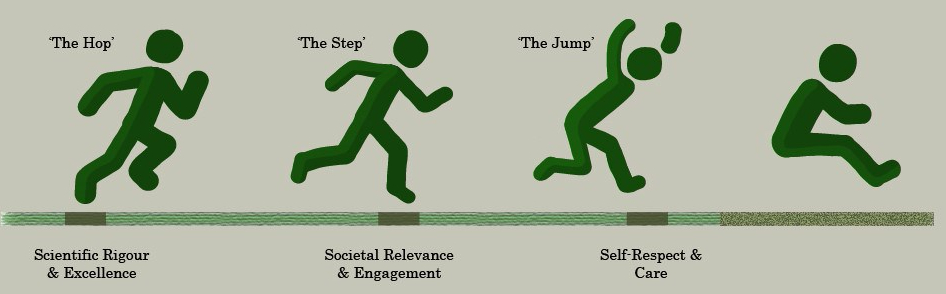
Have you ever watched a triple-jump athlete? It is incredible to see how the athlete executes this three-part movement. It requires excellent technical competencies, rhythm, and the ability to manage each of the three movements in concert. “Every aspect of the jump must be perfect: the run up, the hop, step and the jump”. And each of the movements requires focused attention to specific skills, training and preparation.

The Transdisciplinary Triple Jump

The transdisciplinary triple jump: A three-part movement in which PhD scholars must learn about paying attention to scientific rigour and excellence, societal relevance and engagement, and self-respect and care (Graphic by Caydn Barker).

In our reflections on the challenges of applying principles of transdisciplinary (TD) research in our PhDs, we have come to realise that there are three critical aspects which…

View original post 1,330 more words

The invisible change-makers

By Cristina Apetrei

I recently came across a video about a man who planted 100 acorns a day in a desolate landscape, slowly but surely restoring it over several decades. I remembered that I had previously read this story in “The Global Citizen”, a book which collects columns with the same name written by Donella Meadows. No wonder she liked the story, I thought, as it is not only about the extraordinary determination of one man, but it is also about systems, about leverage points, about vision, hope, and change. By doing a simple, but meaningful, high-impact gesture, day in, day out, Elzéard Bouffier reforested the barren mountains, and that in turn brought life, community, and affluence back to the region.

In sustainability science, we often talk about the need of doing more research on transformative knowledge. We know enough about how the world works and about what we want, we say. Instead, we must increase our understanding about the “how to”, about which actions must be taken in order to achieve the desired outcomes. We endlessly theorize about types of processes, enabling factors and barriers, actors that ought (or not) be involved, absence or presence of facilitators etc., and we try to see how these elements will weave into various outcomes. I won’t discuss here the usefulness of such analyses, some of which I also carry out myself. Instead, I ask: what if realizing “The Sustainability Transformation” is not so much about having sophisticated cognitive insights, as it is about allowing ourselves to be driven by a more personal, more visceral and heart-rooted involvement with the world around?

In my fieldwork, I am often humbled to meet amazing characters. They are the silent, invisible change-makers that you will never hear any story about, who will never get any prize, or recognition, not even an acknowledgement in a paper condemned to eternal rest on a dusty bookshelf in a library.

I see the road to sustainability being paved by the wonderful librarian lady from a forgotten village in Transylvania who, despite better prospects in the nearby cities, felt it was her duty to serve in her little community, even if she now often feels alone and helpless in her plans. With determination and hard work, her village may once rank highest in the region in education and civil engagement, and – just like with Bouffier’s forest – officials will think this success happened on “its own accord”.

Similarly, the road to sustainability was opened by the foreign traveller who taught a community how to make felt slippers as a way to supplement their earnings. With sustained effort, that idea gradually turned into a fully operational women’s association which today, not only creates additional income for its members, but also runs community-wide projects in health and education.

Finally, the road to sustainability is the collective labour of the many farmers, teachers, neighbours, healers, tenders, activists and community leaders who plant their carefully chosen seeds one after another, diligently and devotedly, with the assuredness that the star that guides them shines from beyond their own interest.

Of course, not all stubbornness in action is necessarily beneficial to society, nor even to oneself. Also, not all well intended actions will be useful or have positive rippling effects. In dealing with global change in an interconnected world, sharpness of mind and ethical integrity go hand in hand with clarity of collective purpose. Finding the right lever is as important as knowing what is an end and what is a means. But for me as a scientist, the takeaway of this story is a reminder that, no matter how important, or how transdisciplinary, or how close to the ground our work may seem to us, our intellectual musings alone will bear no rivers to dry lands, no energy to cold houses, no solace to the suffering. We need to carefully look around to see how we, as individuals in our private lives, can also have an impact beyond our formal working hours. What problem in your close environment really moves you? Which chord of your heart could make the most beautiful music if you applied to it the precise bow of your mind?

I urge you all to watch the video, be inspired and go into the world to plant away your acorns! May we be gifted with the “passionate determination and the unfailing generosity of spirit” required for the complicated tasks ahead of us.

Heated discussions in a tropical climate: The 4th meeting of the Transformative Adaptation Research Alliance in Oaxaca, Mexico

By Maraja Riechers

While it might have been 30 degrees Celsius outside, this was not the reason why my head was boiling. We were in Oaxaca, Mexico at this beautiful venue at the Centro Cultural San Pablo – there was sun, good food and hummingbirds. Really, what do you want more?

How about an amazing group of like-minded researchers discussing fascinating topics?

In a post-normal world, scientists tackle problems with ever increasing complexity, chaos and contradictions. In a world with wicked problems, embedded in social-ecological systems, disciplinary science makes little sense. Talking about me and our Leverage points project, I do not have one discipline, and frankly, I do not see the sense in having one. My team and I research human-nature connectedness across 6 landscapes in 2 countries using various empirical social research methods incl. transdisciplinary ones. The landscapes are our boundary objects, and our knowledge stems and draws on various disciplines. Yet, instead of disciplines, a community becomes important. To further my work, I am in need of a plurality of perspectives and “an ‘extended peer community’ consisting of all those with a stake in the dialogue on the issue” (Functowicz & Ravetz 1993:739). Those people in this peer community can be the local actors in the landscape/community with whom one is working, but also the international community that tackles arising problems of environmental changes all over the word, just like you. I found such an extended peer community at the 4th meeting of the Transformative Adaptation Research Alliance (TARA) that took place around the PECs ii Conference in Oaxaca (see my other Blog Posts on the conference here).

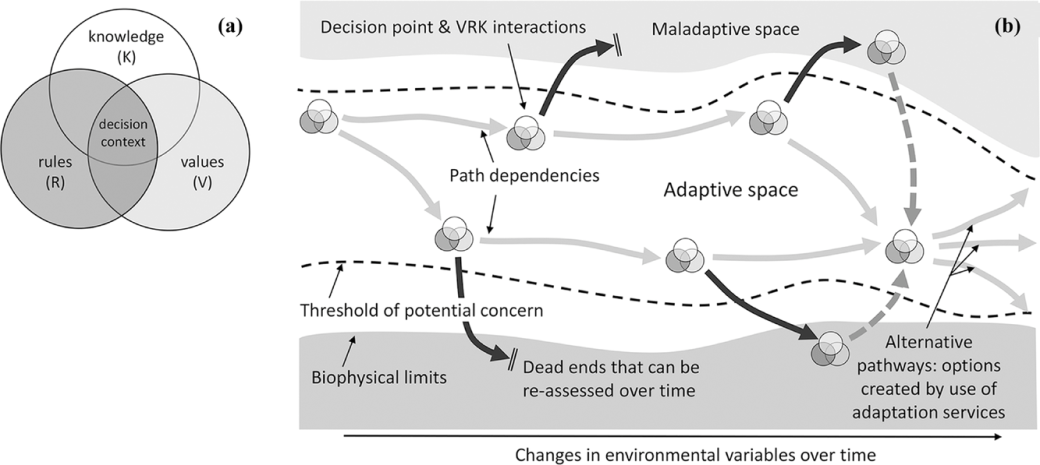
TARA aims to further discussions on reframing nature conservation objectives in the context of global changes. In their paper (or this one) the researchers in TARA “present a case for a transformative approach to conservation and a framework that links global-change-ready conservation with transformative adaptation”. By focusing on the three perspectives of Values, Rules and Knowledge (VRK), the TARA approach aims to embed adaptation to global changes into knowledge co-production processes. “Current conservation objectives are underpinned by normative values (held and assigned), knowledge, and rules, but interactions between them tend not to be considered by decision makers”. Those interactions can, however, greatly impact the success of an adaptation and successful long-term transformation towards a more desirable system state.


Source: Colloff et al. 2017 (see link in text)


TARA sees co-production of knowledge as a vital pre-requisite to diagnose constraints on decision making – and for a solution-oriented new approach to nature conservation under global changes. Scientists, civil society actors, and decision-makers – basically everyone with a stake in the dialogue should be engaged. Through highlighting the underlying values, rules and knowledge systems that often have an invisible yet strong influence on transformation potentials, I saw similarities to our approach emphasizing the deeper leverage points.

Since the influences of the Values, Rules, Knowledge systems are rarely made visible, it is possible that some rules and values are excluded – and some take over the hegemony of decision-making. These points especially fostered a discussion among us around the use and necessity of environmental justice within transdisciplinary research (encouraged by Leonie Bellina): dimensions around participation and recognition were some issues that were brought up in the intriguing sessions. Choosing pathways to respond to the ever more complex and wicked problems is a tricky thing – there are always clashing beliefs on who is responsible (Policies? Science? Everyone?), where should we go (Economic growth? De-growth? Justice?), and what time frame are we looking at (short-term pragmatism vs long-term transformations) and many, many more issues like these. Using the VRK perspectives to focus on the social, political and cultural dynamics of decision contexts, the TARA group argues, can show not only constraints, but also arising opportunities of co-production. To quote Matt Colloff and colleagues (e.g. Lorrae van Kerkhoff and Louis Lebel) again: “This focus enables targeted activities that build on existing strength, such as good relationships between researchers and decision makers, or alert project designers to social-political power dynamics that affect the scale at which research can make the greatest contribution”.

This TARA workshop in Oaxaca in November last year was the first that was open to the public. Hence, many newcomers were integrated into the discussions. What I found incredibly intriguing was the unusually high team spirit. Outsiders like me were welcomed with open arms. There were no hierarchical boundaries and all of us had an equal voice. This spirit created an atmosphere of motivation, inspiration and creativity. It felt like a real idea hub in which the main goal was the exchange of all kinds of knowledge and raising awareness to issues close to our hearts. For me as an early career researcher, this is how I imagined collaboration to look like – across countries, status, disciplines and topics. After those successful 3 days of workshops, we found tangible links for collaboration, created a network for support and frankly also just had a splendid time in Oaxaca and the following PECs ii conference. My head was certainly boiling over with great ideas on how to use this in my research now and in the future – and I am already looking forward to the next TARA workshop!

Scenario planning in Ethiopia

Joern's avatarIdeas for Sustainability

By Joern Fischer

Looking at our publication list, one would think not much is coming from our work in Ethiopia. But there will be! It’s a sad fact of scientific life that others only get to find out about your work three years after you’ve done it. In this post, I would like to summarise experiences from six days of workshops on scenario planning in southwestern Ethiopia.

Preamble: This work involved many people! It was led primarily by Ine Dorresteijn, with important contributions by Jan Hanspach, Tolera Senbeto, Feyera Senbeta, Jannik Schultner, Birhanu Bekele and Dadi Feyisa.

About two years ago, we individually met with 30 different groups of stakeholders, from the local to the zonal government level. With each group, we uncovered possible social-ecological changes and their uncertainties, and with each group, we developed causal loop diagrams of the local dynamics – particularly around food security and biodiversity…

View original post 367 more words

Changing perspectives: doing research in my hometown of Filia, Transylvania

By Agnes Balazsi

I would like to share my experience of being a researcher and a local in the same time in the same project. Personally, I am a convinced environmentalist, therefore this blog entry is highly influenced by this perspective. From scientific point of view, the ‘’data’’ should be interpreted in complex and neutral manner, even in this post. Yet, being a researcher does not free us of emotional influences or personal backgrounds.

Since I was young, I have dreamt about doing something memorable for my community. Research was one of the options. Due to the Leverage Points project and the Transylvanian case study in it, one of my dreams came true.

Two opposite viewpoints have emerged in me – being the researcher and the local. The structured, specialized and scientific approach necessary for data analysis and the implicated personal experience mixed with the memories of my childhood.

I come from Filia, a village in the Inner Eastern Carpathians, surrounded by the South-Harghita Mountains (1558 m), in Transylvania, Romania. The landscape was shaped during centuries by human-nature interactions mostly based on peasant farming and forest exploitations. Filia is no exception of the changes occurring in rural landscapes in Romania in the last decade. Our research is trying to answer how landscape changes influence human-nature connectedness.

Fig. 1

Filia surrounded by its farming landscape

In terms of human nature connectedness, the period after the World War I and the beginning of socialism in Romania (1918-1947) could be generally illustrated by traditional farming landscapes. The connectedness of the community was strongly determined by their material necessities for survival (e.g. food, wood, water, etc.). Anything that sustained life was valuable and highly appreciated in the context of the dominating paradigms of those times. The patrimony (or intergenerational equity and heritage) as the highest value of families assured complex connectedness over the time. Strong emotional and experiential connections sustained by interaction with nature were prevalent as well (e.g. mowing, hunting, firewood extraction, mushroom collection, etc.). Cognitive connection basically meant observation and experience-based knowledge, overlapped with the inherited knowledge about nature between generations (mostly related to farming systems). It is hard to reconstruct the leading threads behind philosophical connectedness, without the influence of interpretation when we look back in time.

Socialism (1947-1989) came with a series of complex changes, starting with the abolition of peasant farming systems, industrialization and development of each economic sector. Rural areas became highly marginalized. The way in which nature was valued changed as paradigms changed, everything was measured in money and its potential of production. Changes in the farming structures led to the functional disconnection of community from the landscape they lived in, and in a deeper sense to the loss of sense of patrimony, property and roots. Industry (coal mining in this area) and services (restaurants, shops) offered at the beginning the feeling of access to well-being and a flowering socialism. However, material connection suffered important changes throughout shifts in the value system: anything able to produce income became valuable. People needed money to have access to food and resources (firewood) on their own heritage. Emotional and experiential connections were limited by forbidden access to state property (forests, collective farms, state farms). Experiencing nature as a way of relaxation became more meaningful once holidays, excursions, sports became accessible for the community. Cognitive connection changed as well, discipline-oriented paradigms started to become dominant over the holistic local knowledge systems. Philosophical connection was infiltrated by the paradigms of socialistic and capitalistic ways of interpreting nature and its resources.

Once socialism fell, the collective farms were destroyed (1990). People reoccupied their land as it was before communism (small-scale parcels), even if formal ownership restitution took longer (or still is not finished). The livestock was distributed between the former members of collective farms and the people tried to continue small-scale agriculture. At the beginning of democracy everything “remained a bit without law” as people said. After 40 years of limitation to own resources people felt entitled to take revenge, using their reclaimed resources to make money (e.g. selling or renting the land, selling the wood). Traditional faming and forestry could not anymore sustain their survival in a modern capitalistic system. Thus, the size of farms increased, while the number of people in agriculture decreased. Due to mechanization the presence of humans in the landscape slowly disappeared. Profit oriented forest exploitation companies appeared, on the remnants of former state companies. Those who were not interested in farming or forestry (or just disconnected through generations) migrated for better living standards to urban areas or emigrated periodically.

Filia is catching up to be a modern society today, despite of its isolated position between the mountain ranges. EU pre-accession and membership came with positive and negative changes. Access to funds favored the development of infrastructure, better environmental regulation and employment abroad. The success of implementation of the CAP and environmental policy at local level is highly disputable. One reason is the quality of the national implementation procedure, and the other is because of local circumstances (e.g. ownership conflicts, wildlife conflicts, marketing of products – incapacity to produce on the EU market, weak environmental awareness). However, landscape functions were preserved due to the continuity of small-medium scale farming (0.5-30 ha). The material connection to nature degraded continuously from previous periods: people getting more and more dependent or interested in imported products of the supermarkets. Emotional and experiential connection became richer again, once limitations were better regulated than in the communist time. Cognitive knowledge has improved because of the access to information and education. Philosophical connection is highly dominated by the environmentalist perspective of valuing nature.

I consider myself lucky, that our playgrounds were the hills, streams, forest and orchards in the surroundings of the village. I especially enjoyed the mowing and haymaking seasons: the smells, the taste of fruits, the sun, the wind, and the rain on my skin. This period meant to me total freedom and security. When I grew up, I physically left the community, but I still belong there in my feelings. Even if I studied agricultural systems and environmental protection, which made me understand the pieces of that “playground”, I sometimes lack the connection with nature that I had. I have never asked our research questions in a scientific way before, but they were asked by the local inside me: “Why did those changes occur?”, “Which are the driving forces that make people act the way they do?”, “Why have things, which were important once, have no more value today?”. I could continue. Basically, changes are not so obvious in the landscape, but the circumstances changed so much, that I am not able to offer a meaningful explanation for myself. As a researcher I am able to understand and analyze the process, but I cannot silence the regrets I feel.

For me, the entire Leverage Points research offered a deep personal process of growing and understanding of changes occurred in Filia.