Scenario planning in Ethiopia

Joern's avatarIdeas for Sustainability

By Joern Fischer

Looking at our publication list, one would think not much is coming from our work in Ethiopia. But there will be! It’s a sad fact of scientific life that others only get to find out about your work three years after you’ve done it. In this post, I would like to summarise experiences from six days of workshops on scenario planning in southwestern Ethiopia.

Preamble: This work involved many people! It was led primarily by Ine Dorresteijn, with important contributions by Jan Hanspach, Tolera Senbeto, Feyera Senbeta, Jannik Schultner, Birhanu Bekele and Dadi Feyisa.

About two years ago, we individually met with 30 different groups of stakeholders, from the local to the zonal government level. With each group, we uncovered possible social-ecological changes and their uncertainties, and with each group, we developed causal loop diagrams of the local dynamics – particularly around food security and biodiversity…

View original post 367 more words

Changing perspectives: doing research in my hometown of Filia, Transylvania

By Agnes Balazsi

I would like to share my experience of being a researcher and a local in the same time in the same project. Personally, I am a convinced environmentalist, therefore this blog entry is highly influenced by this perspective. From scientific point of view, the ‘’data’’ should be interpreted in complex and neutral manner, even in this post. Yet, being a researcher does not free us of emotional influences or personal backgrounds.

Since I was young, I have dreamt about doing something memorable for my community. Research was one of the options. Due to the Leverage Points project and the Transylvanian case study in it, one of my dreams came true.

Two opposite viewpoints have emerged in me – being the researcher and the local. The structured, specialized and scientific approach necessary for data analysis and the implicated personal experience mixed with the memories of my childhood.

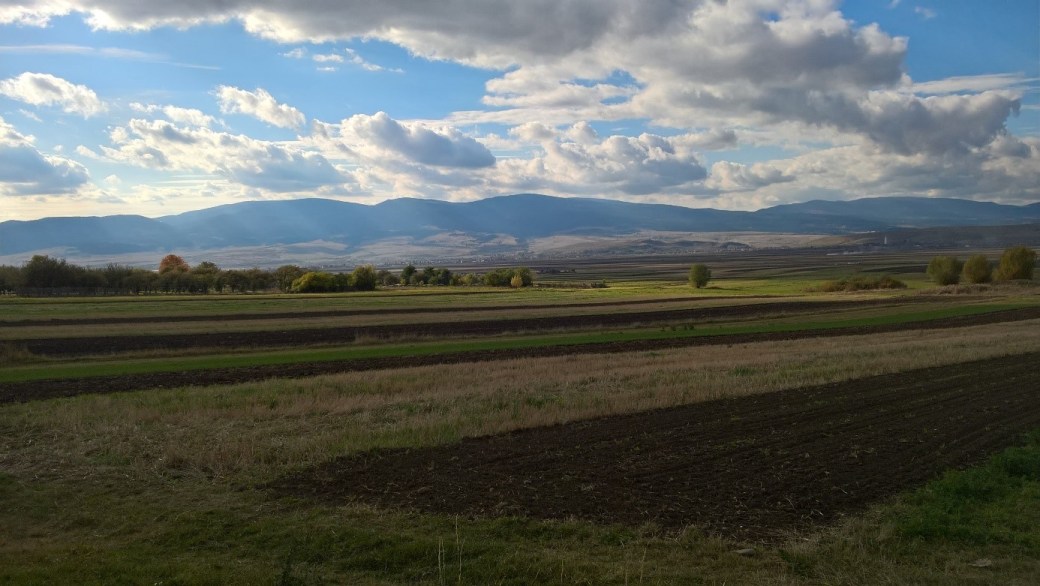
I come from Filia, a village in the Inner Eastern Carpathians, surrounded by the South-Harghita Mountains (1558 m), in Transylvania, Romania. The landscape was shaped during centuries by human-nature interactions mostly based on peasant farming and forest exploitations. Filia is no exception of the changes occurring in rural landscapes in Romania in the last decade. Our research is trying to answer how landscape changes influence human-nature connectedness.

Fig. 1

Filia surrounded by its farming landscape

In terms of human nature connectedness, the period after the World War I and the beginning of socialism in Romania (1918-1947) could be generally illustrated by traditional farming landscapes. The connectedness of the community was strongly determined by their material necessities for survival (e.g. food, wood, water, etc.). Anything that sustained life was valuable and highly appreciated in the context of the dominating paradigms of those times. The patrimony (or intergenerational equity and heritage) as the highest value of families assured complex connectedness over the time. Strong emotional and experiential connections sustained by interaction with nature were prevalent as well (e.g. mowing, hunting, firewood extraction, mushroom collection, etc.). Cognitive connection basically meant observation and experience-based knowledge, overlapped with the inherited knowledge about nature between generations (mostly related to farming systems). It is hard to reconstruct the leading threads behind philosophical connectedness, without the influence of interpretation when we look back in time.

Socialism (1947-1989) came with a series of complex changes, starting with the abolition of peasant farming systems, industrialization and development of each economic sector. Rural areas became highly marginalized. The way in which nature was valued changed as paradigms changed, everything was measured in money and its potential of production. Changes in the farming structures led to the functional disconnection of community from the landscape they lived in, and in a deeper sense to the loss of sense of patrimony, property and roots. Industry (coal mining in this area) and services (restaurants, shops) offered at the beginning the feeling of access to well-being and a flowering socialism. However, material connection suffered important changes throughout shifts in the value system: anything able to produce income became valuable. People needed money to have access to food and resources (firewood) on their own heritage. Emotional and experiential connections were limited by forbidden access to state property (forests, collective farms, state farms). Experiencing nature as a way of relaxation became more meaningful once holidays, excursions, sports became accessible for the community. Cognitive connection changed as well, discipline-oriented paradigms started to become dominant over the holistic local knowledge systems. Philosophical connection was infiltrated by the paradigms of socialistic and capitalistic ways of interpreting nature and its resources.

Once socialism fell, the collective farms were destroyed (1990). People reoccupied their land as it was before communism (small-scale parcels), even if formal ownership restitution took longer (or still is not finished). The livestock was distributed between the former members of collective farms and the people tried to continue small-scale agriculture. At the beginning of democracy everything “remained a bit without law” as people said. After 40 years of limitation to own resources people felt entitled to take revenge, using their reclaimed resources to make money (e.g. selling or renting the land, selling the wood). Traditional faming and forestry could not anymore sustain their survival in a modern capitalistic system. Thus, the size of farms increased, while the number of people in agriculture decreased. Due to mechanization the presence of humans in the landscape slowly disappeared. Profit oriented forest exploitation companies appeared, on the remnants of former state companies. Those who were not interested in farming or forestry (or just disconnected through generations) migrated for better living standards to urban areas or emigrated periodically.

Filia is catching up to be a modern society today, despite of its isolated position between the mountain ranges. EU pre-accession and membership came with positive and negative changes. Access to funds favored the development of infrastructure, better environmental regulation and employment abroad. The success of implementation of the CAP and environmental policy at local level is highly disputable. One reason is the quality of the national implementation procedure, and the other is because of local circumstances (e.g. ownership conflicts, wildlife conflicts, marketing of products – incapacity to produce on the EU market, weak environmental awareness). However, landscape functions were preserved due to the continuity of small-medium scale farming (0.5-30 ha). The material connection to nature degraded continuously from previous periods: people getting more and more dependent or interested in imported products of the supermarkets. Emotional and experiential connection became richer again, once limitations were better regulated than in the communist time. Cognitive knowledge has improved because of the access to information and education. Philosophical connection is highly dominated by the environmentalist perspective of valuing nature.

I consider myself lucky, that our playgrounds were the hills, streams, forest and orchards in the surroundings of the village. I especially enjoyed the mowing and haymaking seasons: the smells, the taste of fruits, the sun, the wind, and the rain on my skin. This period meant to me total freedom and security. When I grew up, I physically left the community, but I still belong there in my feelings. Even if I studied agricultural systems and environmental protection, which made me understand the pieces of that “playground”, I sometimes lack the connection with nature that I had. I have never asked our research questions in a scientific way before, but they were asked by the local inside me: “Why did those changes occur?”, “Which are the driving forces that make people act the way they do?”, “Why have things, which were important once, have no more value today?”. I could continue. Basically, changes are not so obvious in the landscape, but the circumstances changed so much, that I am not able to offer a meaningful explanation for myself. As a researcher I am able to understand and analyze the process, but I cannot silence the regrets I feel.

For me, the entire Leverage Points research offered a deep personal process of growing and understanding of changes occurred in Filia.


What do we value?

Joern's avatarIdeas for Sustainability

By Joern Fischer

In 2012, I led a paper on “Human behavior and sustainability”. Alongside that paper, I wrote a blog post encouraging people to reflect on what it is what we truly value. This was summarized in an open letter, which you can find here.

I thought it’s a nice time to reflect on where my own thinking on this topic is at. With a few years of distance between that initial paper and the open letter and now, some things I see much the same way – and others I see a bit differently.

In the open letter, I implied that many of us probably don’t truly value “ever more stuff” as their deepest life philosophy, but yet we are not actively pursuing what it is that we actually are interested in having more of in our lives. Much of humanity acts as a passive…

View original post 577 more words

Rethink: How can indigenous and local knowledge help us to transform for sustainability?

By David Lam

Albert Einstein said that “problems cannot be solved with the same mindset that created them”. If I look at current sustainability challenges that society is facing (e.g. poverty, overconsumption), most of them are shaped by specific hegemonic ways of thinking which I argue are unsustainable (e.g. the economic growth paradigm).

In my PhD research, I want to understand how indigenous and local knowledge systems can contribute to the transformation process and how these differ to our perspectives in sustainability transformations research.
Loorbach et al. outline three prominent perceptions in transformations research: social-ecological, socio-technical, and socio-institutional, each with different theoretical foci and starting points. This diversity of perspectives to conceptualize sustainability transformations enables fruitful discussions, but we need even more diverse perspectives and approaches.
Recent papers highlight the contributions that indigenous and local knowledge systems could make to our scientific perspectives on sustainability transformations.
Díaz et al. talk about indigenous and local knowledge systems as

 “[a] cumulative body of knowledge, practice and belief, evolving by adaptive processes and handed down through generations by cultural transmission, about the relationship of living beings (including humans) with one another and with their environment”.

Why do I think that this is relevant? I think that Albert Einstein is right in his point that we need to use different mindsets to solve problems than those that have created them. Sustainability challenges are wicked problems. Changing our mindsets to tackle them seems promising to me and also aligns with the concept of deep leverage points as described by Donella Meadows in Abson et al., such as “[t]he mindset or paradigm out of which the system—its goals, structure, rules, delays, parameters—arises” and “[t]he power to transcend paradigms”.

Indigenous and local knowledge systems can differ markedly to our scientific paradigms. In my first year of PhD research, I have been at several sustainability transformations research-related conferences, where I had the pleasure to talk to many inspiring researchers who are involved in research on indigenous and local knowledge systems. During these talks, I encountered interesting examples that made me to start rethinking the way in which sustainability transformations are currently conceptualized in research.

Here are five tentative examples I am exploring to as a starting point to stimulate the way research conceptualizes sustainability transformations: understanding of time, problems, teaching, truth, and resilience.

  1. Understanding of time: linear or circular
    In sustainability transformations research, we think of time as linear, with the past behind and the future in front of us. For the Tsimané people from Bolivá, the past is in the front of them, because they can see it, and the future is behind them, because they cannot see it. They also have a circular understanding of time that is strongly connected to place. They think that whatever they do to their land, they will encounter it in the future as well as their next generation.
  2. Understanding of problems: individual or collective
    In Western society, when someone is sick, they go to the doctor alone for a diagnosis and treatment. In some indigenous and local communities, sick persons are examined differently. If one person in the family is sick, the whole family goes to see the doctor, because the doctor can only understand and treat the sickness by examining with the whole family.
  3. Understanding of teaching: theory or practice
    One friend of mine from an indigenous community from Brazil told me the story of one of her friends who started to study architecture at a university. In one of her first lectures one of her teachers asked her: “How long do the houses that you build in your community last?” “Up to four years.” she answered. The teacher said proudly “Here you will learn how to build houses that last more than 100 years”. Building houses that last longer than four years definitely has benefits. However, a good thing with the other approach is that in this way the next generation learns and practices how to build houses with the local materials every four years.
  4. Understanding of truth: sensemaking through seeing or believing
    There are different ways of sensemaking. Some indigenous and local communities believe in many truths and only in things that they have seen with their own eyes. For example, if there is now no more fish in a lake, someone with this way of sensemaking can see it and believe it now. However, how does such a person believe that there will not be any fish anymore in the future if certain unsustainable fishing practices are kept?
  5. Understanding of resilience: theoretical or practical
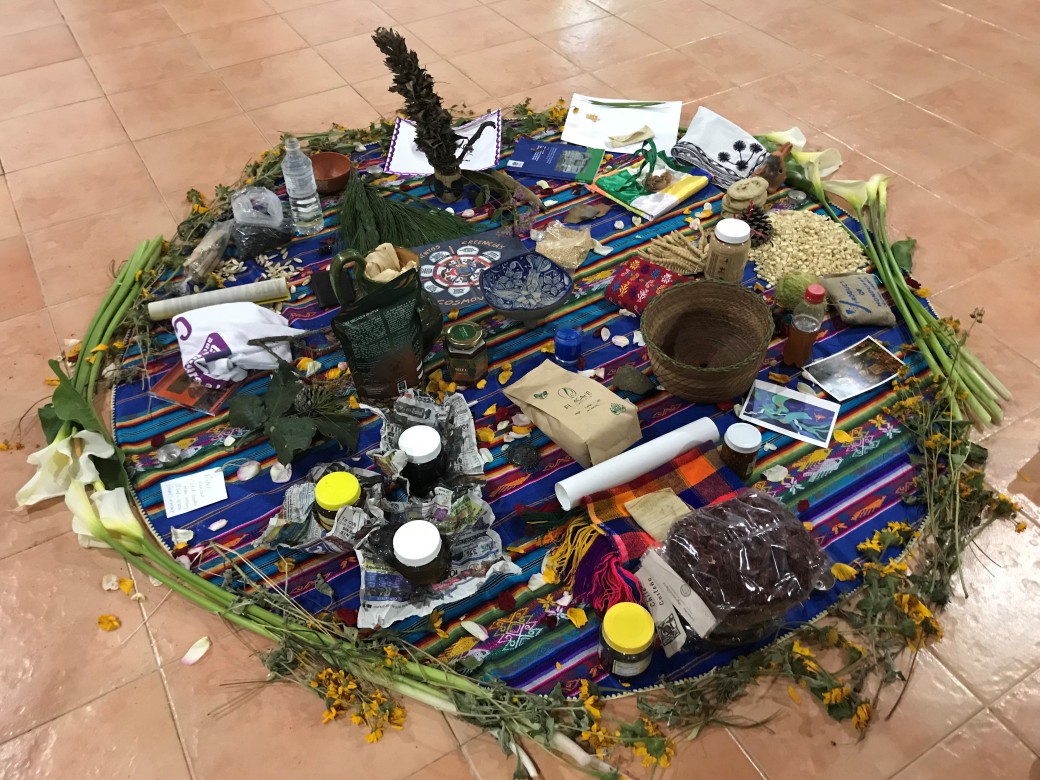
    During a workshop on biocultural diversity in Ixtlán, México, several representatives of indigenous and local communities where asked to bring something from their homes that represent resilience to them. Here is a photo of the things that represent resilience to indigenous and local people (e.g. corn, water, honey, coffee, seeds, and fabrics).

Fig. 1

My research on indigenous and local knowledge in sustainability transformations is focused around these four questions:

  1. How do indigenous and local knowledge systems understand sustainability transformations?
  2. How do indigenous and local knowledge systems understand scaling to foster sustainability transformations?
  3. How do indigenous and local knowledge systems contribute to scaling to foster sustainability transformations?
  4. How can contributions from indigenous and local knowledge systems be scaled to foster sustainability transformations?

Rethinking starts with questioning the way we think by changing your own mindset. Maybe indigenous and local knowledge systems will help us to better understand and foster sustainability transformations.


David P. M. Lam is a PhD student in the research project Leverage Points for Sustainability Transformations at Leuphana University Lüneburg, Germany. His research focuses on two questions: (1) How to increase the impact of local sustainability initiatives through scaling processes in transformations? and (2) How can indigenous and local understandings of change and transformation complement our scientific conceptualization of sustainability transformations?


References:

Abson, David J, Joern Fischer, Julia Leventon, Jens Newig, Thomas Schomerus, Ulli Vilsmaier, Henrik von Wehrden, et al. 2017. “Leverage Points for Sustainability Transformation.” Ambio 46 (1): 30–39. doi:10.1007/s13280-016-0800-y.

Berkes, Fikret. 2008. Sacred Ecology. Second.

Díaz, Sandra, Sebsebe Demissew, Julia Carabias, Carlos Joly, Mark Lonsdale, Neville Ash, Anne Larigauderie, et al. 2015. “The IPBES Conceptual Framework – Connecting Nature and People.” Current Opinion in Environmental Sustainability 14: 1–16. doi:10.1016/j.cosust.2014.11.002.

Jerneck, Anne, Lennart Olsson, Barry Ness, Stefan Anderberg, Matthias Baier, Eric Clark, Thomas Hickler, et al. 2011. “Structuring Sustainability Science.” Sustainability Science. doi:10.1007/s11625-010-0117-x.

Loorbach, Derk, Niki Frantzeskaki, and Flor Avelino. 2017. “Sustainability Transitions Research: Transforming Science and Practice for Societal Change.” Annual Review of Environment and Resources 42. doi:10.1146/annurev-environ-102014-021340.

Meadows, D. 1999. “Places to Intervene in a System.” Whole Earth Winter: 78–84. doi:10.1080/02604020600912897.

Olsson, Per, Victor Galaz, and Wiebren J. Boonstra. 2014. “Sustainability Transformations: A Resilience Perspective.” Ecology and Society 19 (4). doi:10.5751/ES-06799-190401.

Tengö, Maria, Eduardo S. Brondizio, Thomas Elmqvist, Pernilla Malmer, and Marja Spierenburg. 2014. “Connecting Diverse Knowledge Systems for Enhanced Ecosystem Governance: The Multiple Evidence Base Approach.” Ambio 43 (5): 579–91. doi:10.1007/s13280-014-0501-3.

Tengö, Maria, R Hill, P Malmer, CM Raymond, and et al. 2017. “Weaving Knowledge Systems in IPBES, CBD and beyond – Lessons Learned for Sustainability.” Current Opinions in Environmental Sustainability, 17–25. doi:10.1016/j.cosust.2016.12.005.

What does training in translational ecology look like?

Joern's avatarIdeas for Sustainability

By Chris Ives

What kind of a workforce do we need to tackle current and future environmental challenges? This is the question that Mark Schwartz and colleagues recently tried to answer in their recent paper published in Frontiers in Ecology and the Environment. They call for the training and development of “translational ecologists”. But what exactly is a ‘translational ecologist’? Is it a useful concept for navigating future research and teaching or is it just a new buzzword with little substance? In this blog I summarise the paper and provide a few personal reflections. I then mention some exciting job opportunities at the University of Nottingham for new staff contributing to a new holistic, practice-based environmental education programme, similar to those advocated by Schwartz et al.

So what is a ‘translational ecologist’? Schwartz et al. define one as “a professional ecologist with diverse disciplinary expertise and skill sets, as…

View original post 903 more words

The Opening and Closing of a Policy Window for a Coal Phase-Out (Kohlenausstieg) in Germany in 2017 and Beyond

by Pim Derwort

The start of a new year is often accompanied by looking back at what happened in the past and looking forward to the year ahead. While it will take a while for the final numbers to be released, in Germany the Energiewende appears to have come along strongly in 2017. Initial estimates show that the share of renewable energies in gross energy consumption grew to more than 36 per cent, up considerably from the 31.6 per cent in the previous year. Early in the morning of New Year’s Day, for a brief period, Germany was even powered entirely by renewable energy, the first time in modern history.

However, despite the growing share of renewables, coal remained the most important energy source for German electricity production, with around 37 per cent of gross electricity generation coming from coal (with lignite and hard coal accounting for 22.6% and 14.4% respectively) (source: AG Energiebilanzen). The lack of progress in reducing CO2 emissions has led some to openly cast doubt on the country’s ability to meet its climate ambitions and increased calls to reduce the use of coal in electricity production.

In the following post, I briefly discuss the outlook for a coal phase-out in Germany, arguing that the federal elections of September 2017 provided a short policy window for such reform, which rapidly closed with the collapse of initial coalition discussions. At the start of 2018, it remains unclear whether the incoming government will take up the challenge of phasing out the use of coal in electricity production.

Coal Phase-Out

A recent report by Carbon Tracker further concluded that coal in Europe is in a “death spiral”, with more than half of Europe’s coal-fired power plants losing money, and losing 20 per cent of their value since 2010. According to the report, Germany has the largest number of unprofitable coal plants, with RWE and Uniper – the fossil fuel division formerly separated from E.ON – particularly exposed. There is, therefore, a strong economic argument behind calls to actively manage this decline and phase-out coal in electricity generation.

Rogge & Johnstone (2017: 129) argue that, “despite being generally rare and politically challenging to enact, phase out policies are becoming a growing political reality in the context of greater urgency in reducing greenhouse gas emissions”. Indeed, in the aftermath of the 2011 Fukushima earthquake and nuclear disaster, the German government decided to speed up the phase-out of nuclear energy, phasing-out all nuclear-fired power plants in Germany by 2022. And in 2007, the country’s Christian Democratic Union/Christian Social Union (CDU/CSU) and Social Democratic Party (SPD) coalition agreed to phase-out hard-coal mining by 2018.

Nevertheless, calls to rapidly phase out coal in energy generation have not universally been met with enthusiasm. In a televised interview, Reiner Haseloff (CDU, Prime Minister of the formerly East-German state of Sachsen-Anhalt) ruled out an immediate date, stating that there are currently no alternatives for the energy supply, reasonable prices, and the number of jobs associated with the industry. The same sentiment was voiced by Sigmar Gabriel (SPD) who, when serving as Federal Minister for Economic Affairs and Energy in 2016, stated to be unwilling to discuss more rapid phase-out scenario’s without simultaneously talking about realistic scenarios for the creation of sustainable and decently rewarded replacement employment opportunities for those affected by job losses.

So how many jobs are in fact at risk? With respect to the lignite industry, a 2017 study by Arepo Consult, commissioned by the Green Party (Die Grünen) fraction in the German Bundestag, found that the highly mechanised industry accounted for around 20,000 direct jobs in 2016, down from 115,000 in 1991 (see Fig. 1). Over the same period, employment in the hard coal mining industry dropped from around 123,000 to less than 8,000 jobs, with the last mines set to close this year. Another 50,000 indirect jobs are estimated to be generated in the supply chain and supporting industries (see Fig.1 for a development of employment in the sector between 1989 and 2015.

Fig. 1

Fig. 1: Employment in the lignite industry (until 2001 mining industry, from 2002 including jobs in lignite-fired power plants) and hard-coal industry (source: http://www.kohlenstatistik.de).

The opening and closing of a Policy Window in 2017

On September 24, 2017, Germany held federal elections to elect a new government. Following Kingdon’s (1984) Multiple Streams Framework, elections often constitute a routine and predictable ‘policy window’ (Howlett, 1998), allowing policy entrepreneurs to move an item onto the formal government agenda. The outcome of these elections provided supporters of a coal phase-out with some hope.

While the sitting CDU/CSU and SPD coalition managed to hold on to a majority of seats in Parliament, both parties experienced a considerable drop in support from the German electorate. As a result, the SPD – under the leadership of Martin Schultz – concluded it could no longer take part in a Grand Coalition and would instead return to the opposition. This left Merkel’s CDU/CSU with only one credible option to form a majority government: a coalition with the liberal Free Democratic Party (FDP) and Green Party (Die Grünen). Formal discussions started on October 18, 2017.

One of the core themes during the discussions was climate policy. While all parties were committed to achieving both German climate ambitions as set out in the 2010 Energy Concept, as well as its international obligations, how these are to be achieved remained a contentious topic. During the negotiations, the Greens demanded the closure of the 20 most CO2-intensive coal-fired power plants by 2020, with the final closure of all remaining ones by 2030. According to reports on the discussions, Merkel countered by offering to withdraw 7GW of coal-generated power from the electricity grid, equating to around fourteen larger coal-fired power plants. On the subject of a coal phase-out, Merkel remained reluctant – due both to the high share of coal in the energy mix and the large number of jobs dependent on it – and the term ‘Kohleausstieg’ was to be avoided.

Unfortunately, it is impossible to know whether the negotiating parties would have been able to overcome their differences and agree on a compromise. Preliminary talks between the parties collapsed on November 20 after the FDP withdrew from the discussions, citing fundamental differences in political convictions and lack of trust, thereby closing the policy window.

The Outlook for 2018 and beyond

In what is widely regarded as a last-ditch attempt to avoid new general elections, and despite earlier misgivings, SPD and CDU/CSU started preliminary talks to form a new coalition on January 7, 2018.

There is some evidence to suggest the formulation of a policy to achieve a coal phase-out may yet be possible. The SPD Manifesto, made public before the general elections, states that the structural change in the energy industry will continue, with special challenges for the regions hitherto dominated by lignite. It argues, therefore, that regional economic structures must be established and developed to promote employment together with the states, affected regions, trade unions, business and citizens, using federal funds to bring together the new economic activities in the affected regions. Furthermore, at an event in Berlin in early December, the leader of the SPD, Martin Schulz, spoke out in favour of a coal phase-out, whilst taking into account employment in the sector.

Nevertheless, there appears to be some disunity within the party, as reported by Greenpeace Magazine one week later. Whilst Minister for the Environment Barbara Hendricks would like to see a coal phase-out within the next 20 to 25 years (2037-2042), others within the party favour a longer timeframe of 30 to 40 years, thus potentially continuing the use of coal into the second half of the twenty-first century. Furthermore, initial reports coming out of the coalition discussions indicate that the involved parties intend to give up on the country’s 2020 Climate Goals, in an admittance that they are unlikely to be met.

Should coalition talks between CDU/CSU and SPD succeed – as looks likely at the time of writing – the country will almost certainly give up on its 2020 targets, a fact that does not bode well for the formulation of a more ambitious coal phase-out strategy in 2018. In the long run, political will on both sides of the isle will be required for more reflected reforms and a managed decay of the coal industry. With fewer and fewer jobs in the sector at risk, and renewables accounting for an ever greater share of electricity production, another policy window will undoubtedly be available for someone willing to go through it.

Pim Derwort is a scientific researcher at PhD candidate at Leuphana University. As a member of the Leverage Points project and research group ‘Governance, Participation and Sustainability’, his research focuses on the institutional dynamics in sustainability transformations from a policy and governance perspective, particularly on the productive potential of failure and decline. 

A taste of Szépvíz* on a foreigner’s tongue

by Tamara Schaal

This article was written for a local newspaper of the commune of Szépvíz in Eastern Transylvania, Romania, back in October last year. For my PhD, I have been exploring the ‘on-the-ground’ trade-offs related to farming in the Pogány-havas microregion during one month of fieldwork there (if you speak Hungarian, you can find the translation of the article here: http://www.szepviz.eu/kepek/file_19b806cb7e06.pdf) as part of the project ‘Rescaling governance for sustainable agriculture’ at Leuphana University.

In June this year, on a visit to Central Transylvania I came to the Csík valley and Gyimes region for the first time. Despite the veil of rain that lay in the air that day clouding the view of the area and after a very short introduction to the region by Váli Csongor, I knew that I had come to a very special place. A place, surrounded by mountain ranges and snowy peaks, where the forest meets the smaller and bigger land parcels in the plains.

I am very lucky that I had the opportunity to return to this marvelous area for four weeks of fieldwork now. Currently I am interviewing farmers from the region in order to get a glance at how they view farming, what lies behind their motivation and the challenges that they are facing. Despite having only spent less than two weeks here, what amazes me is the determination with which people here continue working their land, their intricate connection to the land, and their attitude of doing what needs to be done – despite the hardships of a harsh climate, uncertainties and the financial insecurity they are facing.

Fig. 1

Cabbage harvest and sale during the cabbage festivities

Of course, to gain a better understanding of farming in the region requires one to use all the senses. Speaking and hearing about agriculture and seeing the landscape only provides part of the picture. Last weekend, I had the opportunity to attend the cabbage festivities in the commune of Szépvíz (Káposztavágás-vásar Szépvízen) and taste the fruit of all the hard work that these people put into farming. That day was a perfect mix of smelling the different flavors put together during cooking, tasting various delicious cabbage dishes, and seeing and listening to the traditional singing and dancing, not to mention that everything was framed by a blue sky and bright sunshine. I think this was a perfect way to glimpse into the culture and traditions tied to village life in this area.

Fig. 2

The farming landscape around the town of Szépvíz

I am grateful for how kindly people here are treating me and particularly to anyone setting aside time from their work to talk to me – a stranger who only speaks a couple of words of Hungarian. This stay has offered me a new vantage point on small-scale farming and I hope that by doing this work I can contribute to understanding how EU policies can better address the challenges that farmers are facing in this region.

For a personal reflection on fieldwork in this area, I also highly recommend my PhD colleague Ioana’s article https://leveragepoints.org/2017/12/07/the-story-of-my-fieldwork-experience-or-whats-almost-always-left-out-from-scientific-papers/.


* Note: Since Hungarian ethnics form the majority in this microregion, the names of locations are in Hungarian in this article.

Happy (transformative) Christmas

By Marlene Roellig

The same scenario keeps repeating every year: The time that is supposed to be quiet and peaceful turns out to be the most hectic time of the year. Not only are there pressing deadlines at work every day, but also in our private life we tend to be stressed about presents, decoration, grocery shopping and getting the family together. On top of that, Christmas seems to be all about consuming. We buy presents which eventually end up in the basement, wrapping paper is piling up the bin and the food leftovers are enormous. Journals and the internet are full of suggestions on how to be more relaxed during this time and how to celebrate a more sustainable Christmas (see also this short article in the Huffington post). During the last few years, I tried all kinds of different ways to make Christmas less about consumption, more about family and more eco-friendly. Some things turned out to be easy, some things are difficult and some things simply do not work.

I would like to share some of my personal experiences and struggles regarding some (quite typical) suggestions for Christmas as you maybe find yourself in this list, reflect on your own traditions or would like to share some of your frustrations or successes on this topic in the comments:

Less Presents
When it comes to presents, I guess for me it is the most difficult part about Christmas. I do not like to buy stuff that nobody needs, but by asking everybody what he or she wants, all the surprise is gone. With my family being spread all over Germany, it is difficult to guess what the others might need, or want. We tried quite some different things in our family (which only consist of adults!):

  • Making wish lists: Well… as I said the surprising moment is gone then
  • Having the same (small) budget for everyone: This feels like you could buy your own present
  • Vouchers for activities*: This will never happen because we live too far away from each other
  • No presents: This felt super weird on Christmas eve (in Germany the presents are given on the 24th December in the evening)

In the end, we decided to go for no presents, because we realized how much it reduces the stress for everybody in the time leading up to Christmas. Yes, it felt weird the first and maybe second year, but as we got over the routine, it turned out to be nice. I certainly understand that this might not be an option for families with children or family members that are very attached to the tradition of giving presents.

Sustainable Christmas tree
Also for the Christmas tree, I came up with all kinds of ideas, driving my family nuts (honestly!). Buying a tree just to watch it die over the days made me feel bad, especially since the trees are often grown in monocultures where a lot of pesticides and fertilizer are used (at least if you buy them in these stands next to the supermarkets here in Germany). To avoid that, over the years I forced my family to:

  • Have no tree: Super sad!
  • Have a tree with roots in a bucket I: Nice idea, but as we don’t have a garden we had to throw it away after Christmas as well
  • Have a tree with roots in a bucket II: We found a place to replant it, but the soil was frozen so we had to keep it on the balcony – after all, it died.
  • Have a tree with roots in a bucket III: I made my mom bring it back to the garden centre after Christmas. The gardener just stared at her, but after some discussion he took it back – we do not know what they did with it after that…
  • Have a branch of some tree cuttings (in our case sloe (Prunus spinosa)) instead of the usual Christmas tree: I loved it, but part of my family was not so excited about it.
picture 1

Alternative Christmas tree from a sloe branch

This year, we will try to find a tree to rent or we will go for the branch again (see picture). As you can see, there is room for improvement! If you still like the idea of having a tree (as we still do) you can find some suggestions here and for the German speaking ones also here.

The food…
In our family, this is always a topic of debate as the way of eating seems to change every year. We had many different variations: from one person being vegan, another vegetarian, two people being vegetarian to everyone eating meat.

So far we tried:

  • Vegetarian food
  • Traditional Christmas food and vegetarian options
  • Indian food instead of traditional Christmas meals (mostly even vegan)

However, it seems that when it comes to food no “rule” is working; we are starting from scratch every year pondering over what we want to eat. Most of the time it ends up being a mixture of vegetarian and non-vegetarian, traditional and non-traditional food to make everybody happy.  By the way, the traditional food in Germany on Christmas Eve is potato salad and wiener, something that actually can easily be made vegan. Otherwise, we just try to buy regional and/or organic products as far as possible and avoid too many leftovers.

Ultimately, Christmas means somethings else for everyone, Christmas has different traditions and everyone has his or her own thoughts about it. Over the last years, I learned to be more patient with my family for not being so enthusiastic about my attempts to make Christmas more sustainable, but we are re-trying every year again to improve small things to slowly transform Christmas. I think it is, especially working in sustainability science, about balancing your own ideas about a more sustainable Christmas with traditions important to you and your family; making compromises and most importantly enjoying the time you spend with your family – that many of us do not get to see that often.

On that note: Happy (transformative) Christmas everyone!


*If you like the idea of vouchers for activities “Zeit statt Zeug” (English: “Time instead of stuff”) has some good ideas.


A landscape approach to sustainability

Joern's avatarIdeas for Sustainability

By Joern Fischer

A few days ago, I was part of an online panel discussion organised by the Global Landscapes Forum.  We discussed questions about what a landscape approach is, and how it might be implemented — and we touched on many interesting topics and identified challenges for the future. The webinar was recorded and is available on youtube; or you can watch it directly here.

View original post

The Embers Of Community

By Jonas Gleitz

 This blogpost is part of a transdisciplinary student project in the region of Oldenburg taught by Moritz Engbers, Ulli Vilsmaier & Maraja Riechers

Dieser Blogpost ist Teil des Studentenprojektes Transdisziplinäres Projekt: Landkreis Oldenburg im Master Nachhaltigkeit. Lehrende: Moritz Engbers, Ulli Vilsmaier & Maraja Riechers

A small shack surrounded by fields. A ridiculously huge bonfire. Old and young people gathering around it. Some dancing, some just staring and probably admiring. Easter Saturday in Germany’s rural areas has quite some fun and horror to offer, depending on your perspective. When I last overcame my initial reluctance and attended one of these occasions, everybody seemed to remember my name from last time I was there. The major and his family, which I knew by chance, pulled me right to the bar and served the obligatory „Cola-Korn“. To all non-German readers: It is Coke mixed with a clear alcohol made from grain. It will get you drunk.

From that moment on it seemed unimportant to whom or what I was talking about if I was dancing or just admiring the fire. I refuse to believe it was just the alcohol. Nobody cared whether I was a scientist or a farmer. There was a sense of „togetherness“ transcending social categories. We were together in the same place and time, sharing a magnificent experience.

This reminded me of how easy a feeling of community can be achieved. But when we talk about creating exactly those meaningful experiences of community in transdisciplinary science it appears to be far from easy. In this Blog post I want to explore the possible lessons that we might be able to take from my evening at the bonfire. By this I do not aim to advocate the use of alcohol in science, I would rather like to work out some underlying elements – metaphorical speaking, the embers – of community for collaborative (science) processes. It may be that at the bonfire, I happened to be in the presence of especially tolerant and empathetic individuals. But this might be unlikely.

Transdisciplinary research involves people from as many different branches of society as needed to work out complex problems. For this, Lang et al. 2012 recommend a strong team-building phase and emphasize the importance of developing a „common language“. This means finding a space in which a diverse team of collaborators can work together at eye level. Obviously that can be difficult because some individuals might prove themselves to be reluctant (as I was at first with attending the bonfire) to accept others as their equals. Yet, some occasions and some individuals appear to have certain qualities that work against the forces of separation. So what are the pillars of communal space? And what specification does such a space need in order to naturally be accepted as what it is? Alternatively: what made all individuals at the bonfire suddenly speak a similar language?
Vilsmaier and Lang 2015 in recurrence to Graham Fairclough, argue that transdisciplinary research and learning spaces are sort of a no man’s land. Meaning:

„…places that do not belong exclusively to one person but are shared and used by many people as a common good. [. . .] As a place of complex resources shared in common, they reflect community and collectivity, but at the same time they lay outside and challenge many norms of ‚society.

In no man’s land everybody is supposed to be equal. To me this sounds a little like temporal anarchy (reminding me again of the bonfire). Let’s stay with this notion: In an anarchic space everybody can be brutally subjective. Does this mean, that you can do whatever you want? Yes. It does. But it does not mean that you should. It also does not rid you of your empathy. What I am saying here could be called Satyagraha: the Soul Force or Force of Truth – doing what you know is right (Gandhi 1968), in a sense of composure in social practice.

The guiding principle that makes you act accordingly to Gandhi’s concept is not knowledge. It is the unifying and humbling experience of being part of something bigger. In this case the imaginary anarchic space of the bonfire. The realization that all of the people in it are there to enjoy the occasion and that everybody will be their most subjective, conflict arousing self, forces them to be empathetic. The humbling experience of the fire itself makes them experience the importance of community and collectivity. One could argue that all humans are similarly unified by the world itself. We all share a need for food, shelter and love which implies the need for the world, life and community itself.

Fig. 1

The author at a bonfire

I heard Vandana Shiva this year in a presentation at Kampnagel in Hamburg, were she argued that all humans have these things in common. At least we are connected by the roots and seeds of our food (Compare to her TEDx Talk). Such are topics of major relevance to sustainability science and I think that transdisciplinary science should integrate them and the humbling experiences of connectivity into the collaborative process.

Maybe we should find activities that include the above stated basic human needs and combine them with a grand experience. If all collaborators shared such an experience it would remind them of their basic human connection and hopefully makes them feel a sense of community.

It would be necessary for every individual to actively participate in that activity and of course this activity has to include everyone. I also believe that such an event should „force“ everybody to be brutally subjective and empathetic at the same time. In recurrence to my own experience, this is the only way to gain mutual understanding and a true sense of community. There may be conflict and reluctance at first, but if the team-building phase can make the collaborators overcome these obstacles, it will make the group’s sense of community thrive. A bonfire may not be the perfect fit for environmentalists or sustainability scientists but every team will require different experiences anyway. I think that transdisciplinary scientists should spend some time on finding fitting Embers of Community for their collaboration and take responsibility for making them into a bonfire.


References:

  • Gandhi, Mohandas Karamchand (1968): Satyagraha in South Africa. In: Selected Works of Mahatma Gandhi Volume Two.
  • Lang et al. (2012): Transdisciplinary research in sustainability science: practice, principles, and challenges. In: Sustainability Science (2012) 7 (Supplement 1).
  • Shiva, Vandana (2012): TEDxMasala – Dr. Vandana Shiva – Solutions to the food and ecological crisis facing us today. At: https://www.youtube.com/watch?v=ER5ZZk5atlE (Last visit: 28.09.2017).
  • Vilsmaier, Ulli / Lang, Daniel J. (2015): Making a difference by marking the difference: constituting in-between spaces for sustainability learning. In: Current Opinion in Environmental Sustainability (2015).