New paper: Many pathways to sustainability, not conflict but co-learning between transition narratives

There is an increasing focus in sustainability science on transitions and transformative change and an increasing number of proposed pathways for transitioning towards sustainability. In a new paper by Chris Luederitz and colleagues we discuss four archetypical transitions narratives (the green economy; low-carbon transformation; Ecotopian solutions and the transitions movement) in terms of the kinds of interventions these different approaches engender and the ‘depth’ and nature of systemic change they seek achieve.

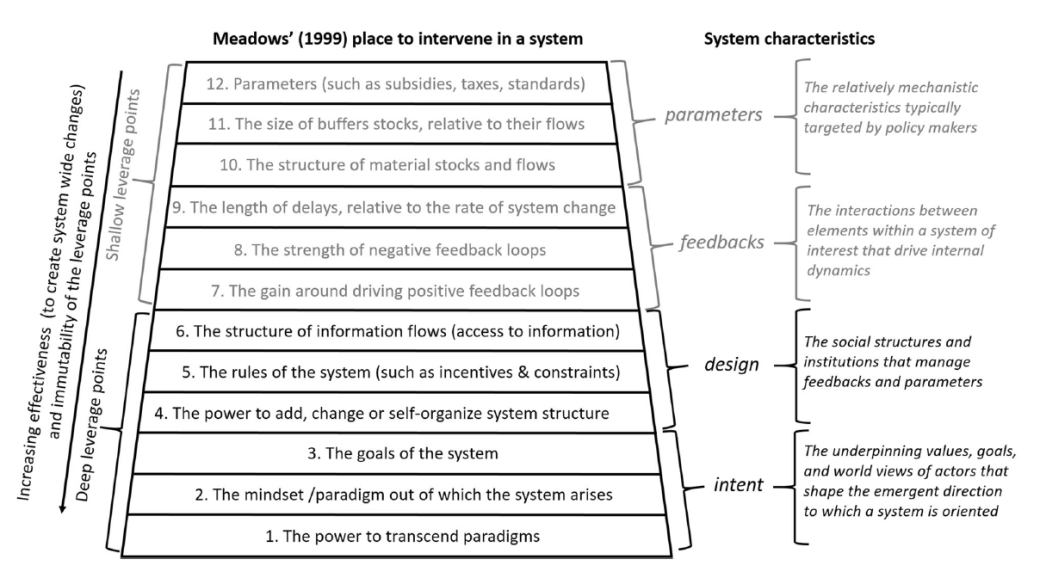
In addition to summarizing critiques of these four approaches to transformative change, we draw on Donella meadows’ ‘leverage points’ concept (see also here) in order to characterize the different narratives in terms of their potential to enable systemic change.  The different transitions narratives seek to act on different system characteristics ranging from system parameters (taxes, incentives, rules) and system dynamics through to challenging the fundamental design, rules, values and goals of the system. We therefore argue that rather than representing competing visions for societal change, there is considerable scope for co-learning between these different approaches. By understand where in a system a given transitions approach does or does not seek to intervene we believe it is possible to combine facets of these approaches to create a more holistic transitions pathways that act on multiple leverage points for systemic change.

Luederitz, C., Abson, D.J., Audet, R. and Lang, D.J. (2016) Many pathways toward sustainability: not conflict but co-learning between transition narratives, Sustainability Science. doi: 10.1007/s11625-016-0414-0

Hiring now: Postdoc on human-environment connections

Joern's avatarIdeas for Sustainability

By Joern Fischer

Because one of our postdocs is moving on to a tenured position (congratulations!), we are looking to find a new person to join our project on “leverage points” for sustainability (see, for example, here and here, or here). This position will be collaborating closely with others, especially myself, Henrik von Wehrden, Dave Abson, Julia Leventon, and several PhD students working on the “re-connect” component of the project.

Although somebody else has previously held this position, there is a lot of flexibility for how the position can be filled with life and meaning in the future. We’re particularly looking for somebody who is interested in pursuing empirical work on human-environment (re-)connections in Transylvania (Romania) or Lower Saxony (Germany) (or both); focusing on food or energy systems (or both). You can email me if you have questions.

The official advertisement is available here. Below, I copy and paste that information, but…

View original post 694 more words

Romania – where there’s a will, (I think) there’s a way to achieve sustainability

Ioana Alexandra Dușe

I begin this blog post by saying that Romania is truly amazing, with valuable agricultural landscapes and breath-taking views.  Some might say that I am biased, but of course I am; I was born, raised and, for a big part of my life, educated there. However, I see a lot of problems in Romania, in terms of politics (institutional transparency, corruption at the highest level), education, rural to urban migration, environment and sustainability issues. So, the question is why should we pay attention to all of these problems? Well, first it is relevant for us in terms of research, there is a lot of potential for good research to be done in the area. Second, we have to understand the underlying causes of the problems and the symptoms in order to understand how to tackle these issues, and third, because there is no such place like Romania and when one has an opportunity like this, one has to find a way to build on this.

In May, this year, members of the Leverage Points team (Andra, Pim, Nicolas, Chris and I) headed to Transylvania for a week of scoping fieldwork and exploration. Our aim was (1) to see how can we frame our research questions to the Romanian context; (2) to see how can we pursue our objectives considering the complex problems that Transylvania is facing in terms of food and energy systems, and nevertheless we wanted to have a taste of Transylvania (believe it or not, Dracula was not part of the story, this time!) We had 21 meetings with stakeholders from academia, NGOs, local action groups, local government, farmers associations, activist groups, and many others. The amount of information we gained during scoping is very helpful to our future work, a lot of interesting discussions were generated. Here I will just give an overview of the highlight of the meetings, and a few key emerging points.

How are Transylvanians connected to nature?

In Romania, for centuries highly diversified subsistence agriculture and production supported the population. The region of Transylvania still relies on traditional rural land use, often considered ”antiquated” in Central Europe. Farmers in the traditionally managed areas do not use chemicals or intensive machinery, and this has created a large variety of landscape structures, plant communities and habitats for animals. Biodiversity in traditional farming landscapes is also supported through mutual socioecological relationships, in which rural communities influence ecosystems and vice versa. This reciprocal relationship provided strong incentives for sustainable land use, however, the benefits people derive from nature are tight to their value systems and to their connectedness to nature.

Transylvanians perceive, value and interact nature differently. People from the rural areas (who call themselves “peasants”) are very pragmatic and understand nature as more the way through which they benefit from it and appreciate it for livelihoods. Elderly people tend to have a different appreciation for nature, they, have a unique connection to the land, especially compared to younger generations who grow more disconnected from the land/nature. This disconnection is amplified by migration. As more young people leave the rural areas for economic reasons and go to work either in close urban areas in Romania or leave the country, the traditional values related to nature in the region no longer flow from generation to generation to the extent that they did once.

People from urban areas appreciate nature for aesthetics, recreation, and only a small proportion of young people in Romania started developing this feeling of “going back to the roots” for (re)discovering the traditional rural life.

There is another category of people – tourists – who seem to be more aware of the values of the landscape, want to protect it, and appreciate the beauty of the region. These people look for the benefits of the landscape from the natural perspective of the elements. In other words, their connection to nature is oriented towards subtle forms and naturalness.

What are the major sustainability challenges, causes and solutions?

Across Romania, Transylvania included, natural resources have become the object of speculation and massive investments, wherein land owned by millions of Romanian peasants is being grabbed and transformed with far-reaching effects. Some of the foreign visitors have become the famously known “land grabbers”. Data from official registries shows the strong presence of banking institutions and investment funds like Rabobank, Generali or Spearhead International. The range of investors is “exotic” from Austrian Counts, to Romanian oligarchs and Danish and Italian agribusiness companies. Legislation has been driving changes in large-scale monoculture farming, forestry, mining, energy, tourism, and ultimately speculation – as a process that is weakening rural economies and hampering the development of a dynamic rural sector. Urban-rural migration remains a problem along with agricultural intensification, foreign ownership, and the loss of traditional agriculture. Some of the causes are linked to the value systems of the locals and their mind-sets, the level of poor education, unemployment and short term thinking, focused on immediate benefits. Most of the time this shows the lack of hope, pride and support from authorities and responsible institutions.

Energy – seems rather a vague topic for discussion, especially when it comes to renewables and to the support given by the public and by the legislative framework, which is inexistent. People in urban areas still use gas- as the primary energy source whereas people in rural areas rely much on wood.

As for solutions, it will take time to change minds and value systems, and to heal the wounds that history left in Romania after the collapse of the communism. There is still sort of nostalgia floating in the air, but we (as researchers) need to understand what the practical solutions are that trigger sustainability, what are the drivers that shape behaviour, re(create) values for nature appreciation, economic sustainability and legal structures that enable all this to occur.

The role of (in)formal institutions, collaboration and social capital

The informal institutional landscape in Romania seems more and more vibrant. What we witnessed is an outstandingly strong collaboration between public-private actors; local governments and companies/foundations have shared goals and a common vision for a sustainable future. Social capital seems to be the catalyst in this region. In many of our discussions, we came down to the idea of drivers that facilitate mutual beneficial relationships among individuals and collective actions, resulting in longstanding collaborations. So, trust is important and this can be gained and maintained through learning interactions and mutual support. On the other hand, issues such as the legal frameworks, excessive bureaucracy (too complicated, time consuming), and the constant changes to “rules of the game”, are seen as barriers for development. The Romanian Government is pushing on with the development of agro-industry and making substantial efforts to attract foreign investments. The Government’s Program for the period 2013-2016 clearly states it wishes to move towards very large scale, export-oriented agriculture. In Romania, as traditional and organic farmers are being marginalised, land is becoming merely a commodity on which companies can speculate. As some might say, land has become “the new gold”.

One glimmer of hope is the momentum behind participatory groups.  NGOs, researchers, some local institutions, and more responsible and active citizens saw the potential in Romania and decided to help to build a more sustainable future by involving the locals and making them proud of what they have. In one of our discussions, someone said something that keeps coming back to me as a good principle in life: “If this should work for me, it should work for somebody else as well”. How this might play out in the Romanian context in the near future remains to be seen.


We had discussions with: Dr. Tibor Hartel, Mihai Eminescu Trust (Caroline Fernolend), Adept Foundation (Ben), Dan Craioveanu, Asociatia Neuerweg (Hans Hedrich), Mioritics (Mihai Dragomir), GAL “Dealurile Tarnavelor”, GAL “Microregiunea Hârtibaciu”, Bunești City Hall, Mayor Saschiz, Asociatia Monumentum (Eugen Vaida), Asociatia CasApold (Sebastian Bethge), BioMoșna (Willy Schuster), Valea Verde Retreat (Jonas and Ulriche Schäfer), Cincșor Guesthouse (Irina Ciungu Suteu), Faculty of Political Science, BBU Cluj (Dr. Gabriel Bădescu, Dr. Cosmin Gabriel Marian and Drd. Mădălina Mocan), Faculty of Biology, BBU Cluj (Dr. Marko Balint), EcoRuralis (Boruss Szocs Attila)

 We thank all for their valuable insights and elaborations!

 Reference:

Boruss Szocs M.A., Rodrigues Beperet M., Srovnalova A., Land Grabbing in Romania – Fact finding mission Report, EcoRuralis, April, 2015 (online: https://drive.google.com/file/d/0B_x-9XeYoYkWUWstVFNRZGZadlU/view )

 

Two New Post Doctoral Postions in Leverage Points

Leuphana University Lüneburg (foundation under public law), Faculty of Sustainability invites applications for 2 new post doc positions within the  transdisciplinary project funded by the State of Lower Saxony and Volkswagen Foundation entitled: Leverage Points for Sustainability Transformation: Institutions, People and Knowledge

The first position (PD3a) “transdisciplinary case studies” contributes to the consolidation of the epistemological and methodological foundations of transdisciplinary case studies.  The themes of the case studies will revolve around the food and energy systems in Lower Saxony (DE).

The second position (PD3b) “Sustainability-related knowledge creation and use” focuses on consolidating conceptual foundations related to the role of knowledge including (new) forms of knowledge production and use to foster sustainability transformation.

both positions are for  50% post doctoral research associates– Wissenschaftliche/r Mitarbeiter/in, salary group E 13 TV-L. Starting ideally September 2016, up until 31st March 2019.

Successful candidates will join an interdisciplinary team of eight principal investigators, five post docs and eight PhD students, all located at Leuphana University.

Application deadline: 3rd August, 2016

To apply
The official job adverts for both positions and details of how to apply can be found at http://www.leuphana.de/bewerben/jobs-und-karriere/forschung-lehre.html PDF versions of the official adverts can be found at here:  Leverage_points_PD3a Leverage_points_PD3b

Now published: Leverage Points for Sustainability Transformation

Joern's avatarIdeas for Sustainability

By Joern Fischer

Finally, the first paper is out from our Leverage Points project. It’s led by Dave Abson, and lays out a conceptual framework and research agenda, all around the notion of “deep leverage points”. Please share it through your networks.

Screen Shot 2016-06-28 at 10.31.56.pngThe paper draws on Donella Meadows’ notion of “deep leverage points” – places to intervene in a system where adjustments can make a big difference to the overall outcomes. Arguably, sustainability science desperately needs such leverage points. Despite years of rhetoric on sustainability science bringing about “transformation”, the big picture is still pretty dull: globally at least, there is no indication that we’re starting to turn around the patterns of exponential growth that characterize our era. A potential reason is that much of sustainability science has focused on parameters and feedbacks, rather than system design or “intent” (see above) — when actually, it’s changing a system’s design…

View original post 255 more words

If at first you don’t succeed.. Institutional Failure in the Public Sector

derwort2015's avatarSUSTAINABILITY GOVERNANCE

A review of Public Policy and Administration’s special issue on policy failure

By Pim Derwort

In many ways, failure is an inevitable part of life. In many cases, it is also something we would rather not be reminded of and may be hard to accept. Some of the most inspirational movies and stories teach us how to accept or ‘let go’ and ‘move on’ from failure, or to learn from our mistakes on a personal level and generally become better persons for it. But what happens when failure occurs in the public sector?

In the public sector, ‘getting it wrong’ can have significant (and damaging) consequences for those affected. It can significantly damage the public’s trust in the political system, damage individual’s careers and, in extreme cases, may even lead to injury or loss of life. While failure may be just as inevitable, it is all the more important to…

View original post 1,227 more words

Student-driven literature reviews (part 2)

sbpartelow's avatarSustainability Logbook

By: Henrik von Wehrden

This blog entry is a follow-up to Chris’s perspective (Part 1) on our joined review efforts. But let me back up first, and explain how I got into reviews to begin with. My first review started out of the frustration of an inadequate understanding of the literature, and contained a few thousand papers that I reviewed all alone. I greatly enjoyed the process despite all the suffering, yet this was back during my PhD, when I somehow had more time. When I entered my assistant professorship it dawned pretty quickly on me that from now on I cannot shoulder such a workload alone. Also, would other people not gain experience by reviewing papers as well? This was the point when I perceived the general idea of a student driven review.

What was now the most crucial point being the fact that I was in the perfect…

View original post 854 more words

Student-driven literature reviews or a 5-year long journey in academia

cluederitz's avatarSustainability Logbook

Little did I know when I enrolled in my bachelor that a single student project could influence one’s scientific development for years. In fact, because of one extracurricular project, I published three peer-reviewed articles, initiated an international university collaboration and developed an educational approach to merge teaching and research in sustainability science. Well, to cut a long story short I did none of this on my own but had the fortune to collaborate with extremely thoughtful and ingenious people. Together, we opened the restrictive doors of academia to young researchers eager to engage in science. We broke down hierarchical structures empowering students to leave the theory-rich bubble of their classroom to experience first-hand the often so mysterious world of science and the politics of publishing. But most importantly, we collaboratively started a project that was nothing but fun and an inspiring adventure that will probably in one way or the…

View original post 631 more words

Is connection with nature an oxymoron?

Joern's avatarIdeas for Sustainability

Reflections by Chris Ives, Katie Klaniecki, Christian Dorninger and Joern Fischer

In his recent paper, Robert Fletcher criticises the idea of re-connecting people with nature (and with it, the perspective of “connection with nature”). His main argument is that through the very terminology being used, people and nature are treated as separate entities — suggesting that a true unity of them therefore is going to remain elusive. A people-nature dichotomy, or nature-culture divide, thus is entrenched in the terminology being used, rather than dissolved. As an alternative, Fletcher suggests a political ecology framework: According to this, with industrialisation, a “metabolic rift” occurred, and this alienated people from the environment both materially and philosophically. Such a framework would encourage a broader perspective, which perhaps would do a better job at getting at the root causes of un-sustainability.

We agree with Fletcher that there is a great need for critical reflection…

View original post 383 more words

Being NEAR and FAR: The role of a formative accompanying researcher in the Leverage Points team

Rebecca Freeth

When people ask me what my role is in the Leverage Points project, I tend to take a deep breath before embarking on an explanation. I start with what I’m not doing; I’m not looking at the content of sustainability transitions or the mechanisms of leverage points; I’m not studying food or energy systems in Lower Saxony or Transylvania as my colleagues are.  Actually, I hasten to add, I am deeply interested in all these things.  But I’ve travelled from Cape Town to Lüneburg to study the Leverage Points team itself, to learn about interdisciplinary and transdisciplinary research from the inside (well, from the boundary, with one foot in and one foot out, but that’s for another blog post) and to engender learning within the team itself.   So that we all end up a bit wiser about the how-to of research collaboration across disciplines or, to borrow Ulrike Felt’s evocative term, different “epistemic living spaces” (2009).  To my surprise, most people I explain this to get it first time: “Oh, yes, that makes sense. Collaborative research can get pretty complicated at times.”  And then their expressions cloud a little: “Ooh, that must be pretty uncomfortable for the team, to be your research subjects.”

This job is called Formative Accompanying Research.  FAR.  I have a vivid memory of watching an episode of Sesame Street as a child, in which Oscar the Grouch runs towards the TV screen, until it is filled with his furry face, saying: “This is NEAR” and then runs, puffing hard, into the far distance, until a little speck shouts, “This is FAR”.  Again and again and again – which was endlessly entertaining for children like me.

1.png

Yes, it may be uncomfortable for the team, and for me, at times.  And I could end up doing a lot of running between being close-up and further away, to get perspective.  But the intention is both simple and positive, as articulated in the Leverage Points project description: To gain insights into the research process and keep looping these back into the project to the benefit of the Leverage Points team, and to the benefit of inter- and transdisciplinary methodological development more broadly.

If I think about each of the three words in the job of formative accompanying research, the ‘how’ of this task also becomes a little clearer.

Formative, for me, is the opposite of summative.  Instead of an outsider conducting an evaluation at the end of Leverage Points and pointing out to everyone what went well and what didn’t and what we could have done differently if only we’d known better, this is about learning in situ, and as close to real-time as is feasible.  The advantage is that we can gain insights and course-correct as we go.

In music, accompaniment involves providing the harmonic background or rhythmic structure for a lead singer or musicians.  A good musical accompanier takes their cue from the lead performers and makes sure they are not themselves too loud or too obvious.  This idea strongly appeals to me; I see my task as not being in the foreground, but to get the beat of the Leverage Points project (see principle 1 at the end of this piece) and help create some of the conditions that allow us to notice when we are out of synch, to pause, hopefully laugh a little at ourselves, learn something from the experience and then pick up the harmony again.

Lastly, that little word research. I’m drawn to the characteristically contentious differentiation Bruno Latour made between “science” and “research”.  Referring to science as if it was dead and buried, he wrote, “While Science had certainty, coldness, aloofness, objectivity, distance and necessity, Research appears to have all the opposite characteristics: it is uncertain; open-ended; immersed in many lowly problems of money, instruments, and know-how …”.  (1999:20).  Although the Leverage Points project is located in the field of Sustainability Science – which, it must be said, has done a lot towards resuscitating science since Latour wrote these words – the particular role of formative accompanying research will require some tolerance of uncertainty and ambiguity for all of us, especially in these early months while we are still finding our rhythm.

So, the intention is not to subject the team to great discomfort.  And where I get it ‘wrong’ as a researcher – such as overstepping boundaries, or missing the beat – this will hopefully sensitize all of us to both roles: Being a researcher and being on the ‘other side’ – being researched.

Given that Leverage Points owes its name and much of its conceptual framing to Donella Meadows, I have returned to her for some guiding principles.  She was, by all accounts, not only an incisive thinker, but also a wise, humorous and often kind human being.  Her way of being is already instructive to me.  Donella’s book “Thinking in Systems: A primer”, published posthumously, concludes with 15 principles or “systems wisdoms” for “living successfully in a world of systems” (2008:170).  I concur with most of them, but my current Top Six, which I will try to apply to my practice of formative accompanying research with the Leverage Points system, are:

  1. Get the beat of the system before intervening (as described above);
  2. Use concrete, truthful and rich language, “enriched with systems concepts”;
  3. Enhance whole system properties, such as growth, stability and resilience;
  4. Respect and distribute information, to strengthen feedback loops;
  5. Pay attention to what is important, not just what is quantifiable; and
  6. Offer both a critical and an appreciative lens so as not to “weight the bad news more heavily than the good” (2008:185). I believe we learn best under conditions that feel safe-enough for each of us – knowing we all have different safety thresholds – but not so comfortable that we fall asleep in them.

2

Some of these principles come fairly automatically to me after nearly 20 years of working with organisational teams and inter-organisational collaborations, and some will stretch me considerably over the next three years.

Watch this space.

References

Felt, U. 2009 (Ed.). Knowing and Living in Academic Research: Convergence and heterogeneity in research cultures in the European context. Prague: Institute of Sociology of the Academy of Sciences of the Czech Republic.

Latour, B. 1999. Pandora’s Hope: Essays on the reality of science studies. Cambridge, Massachusetts: Harvard University Press.

 Meadows, D. 2008. Thinking in Systems: A primer. Wright, D (Ed.). Vermont: Chelsea Green Publishing.